Isabelle Vrinat
THE REPRISE: From Text to Image, from Image to Text
(Paper written for the conference “From Text to Image, from Image to Text,” held in Sofia in September 2024.)
«Je me tiens dans l’intervalle enchanté entre peinture et littérature. C’est là que je respire le mieux.»
Yannick Haenel (1)
1. First Reflection: Nikolai Rainov’s Impossible Synthesis
My artistic practice was preceded by a theoretical exploration of the relationship between the arts, which began thirty years ago when, as a student at the Sorbonne, I was writing a doctoral thesis in Comparative Literature on the literary and graphic work of Nikolai Rainov (1889–1954), a Bulgarian writer and graphic artist trained in the decorative arts who later taught at the Academy of Fine Arts in Sofia.
Given my interests and academic background in Modern Literature and Film, Bulgarian language and literature at INALCO, as well as my practice of drawing at the Académie de la Grande Chaumière, I embraced an interdisciplinary approach very early on — at the risk of finding myself unable to choose: which path should I follow? And if I chose one, would I have to exclude the others? I wanted to make films, I wanted to draw, and I wanted a classical literary education. Bulgarian came into my life more by chance.
The thesis topic I had chosen allowed me to bring all these interests together. I studied Rainov’s early modernist literary work and his attempt to achieve a synthesis of the arts through the invention of a poetic “decorative prose,” which he illustrated himself — covers, vignettes and illustrations — thus offering the reader a simultaneous experience of his writing and his graphic art (ill. 1).
This synthesis of text and image, prose and poetry, art and Theosophical belief was intended to embody his quest for a universal truth or a syncretic absolute, at a time when the correspondences between the arts and their fusion into a total work of art were being explored anew. Yet, at the end of my analysis of his Symbolist work — which sometimes became lost in an overabundance of myths and symbols, quotations and borrowings from the writings of others — I came to see in it a difficulty in giving form to his own voice.
It was a strangely negative conclusion for a young student who had not yet written or created anything herself, but had simply spent five years immersed in someone else’s work.
And then I turned my back on the person who had written that thesis, and forgot everything.
.
2. Second Reflection: A First Attempt to Move from Text to Image — and Its Failure
This academic exercise, however, encouraged me to continue writing, this time for cinema, and to begin searching for subjects of my own. I wrote screenplays somewhere between fiction, documentary reality and autofiction. One of them was a short film written in 1997, in which Isa, aged twenty-eight and aspiring to make films, meets a seventy-year-old woman painter during a life-drawing session at the Grande Chaumière. The painter invites her to pose at her home and wants to take their relationship further, much to the surprise of the young woman, who is unsettled both by the older woman’s freedom and by her age — an age she exaggerates in her mind under the influence of Georges Bataille, whom she had read too young — to the point of imagining Death making advances to her, as in Hans Baldung Grien’s painting Death and the Maiden (1517).
In this screenplay, which I called The Skeleton and Sappho, playing on the similarity of the two names in French (Le Squelette et Sapho), I explored the interplay of desire and mirroring that can develop between painter and model — in this case, between two women artists of different generations.
But the screenplay never became a film.
Eventually, I gave up cinema and turned to painting as a way of giving form to my desire to create images. Since 2001, painting had been taking an increasingly important place in my work: in the solitude of the studio, I could create my images directly and more quickly, without needing a technical crew or having to wait for a producer to finance them.
And I turned my back on the person who had written those screenplays, and forgot everything.
3. Third Reflection: To Paint or to Write?
I longed to be reborn — other — through painting, within painting.
But the correspondences I had established between painting and writing through my theoretical work soon began to emerge in my paintings themselves. When I am searching for an idea for a painting, I write notes in a small notebook while simultaneously making sketches (ill. 2): I need both mediums at once.
The same was true of the relationship between my painting and cinema. I began to conceive my paintings as series, in order to recover something of the shot-by-shot sequence of film and introduce a temporal dimension. Later, I even painted landscapes on the backs of large cinema posters, in which a woman can be seen walking or painting (Those Who Fall Have Wings).
Then, “midway in the journey of my life,” I wanted to “construct my painting like a book, or a film, or a theatrical drama,” as I wrote in a notebook beside sketches for paintings — with a beginning, acts and an ending, as I had done in my screenplays. I wanted to return to narrative painting, which had become almost taboo in painting since the end of the nineteenth century.
Drawing inspiration from the opening lines of Dante’s Divine Comedy as well as from Ovid’s Metamorphoses, I created a body of paintings, drawings and monotypes that I called I Found Myself in a Dark Wood: to lose myself, too, in my own dark wood, in the hope of finding myself — and of finding my image somewhere between abstraction and figuration, my path somewhere between painting and literature.
And if I identified with Dante, lost midway through the journey of his life, I chose two guides to show me the way in my own search for a narrative form of painting: Paula Rego and Gérard Garouste, two contemporary painters who, from the 1980s onwards, revisited and reinvented the principle of ut pictura poesis. I began with my first painting: Narcissus looking at the viewer — his reflection.
This body of work, which gives visual form to myths involving the forbidden gaze — Narcissus, Actaeon — was my first attempt at a synthesis between painting and writing. Yet it concealed the sense of inner division, the dilemma I was experiencing at the time: between the woman who paints, the woman who keeps a journal reflecting on her artistic practice, the woman who had once written screenplays, and the woman who speaks about the history of painting before an audience. I felt I had to be one or the other.
When I painted, I suffered from not writing. When I wrote, I suffered from not having enough time to paint. How could I resolve this dilemma, this “Either/Or,” and make it cease to be one?
Was I once again going to turn my back on the person who had spent nearly seven years painting this body of work, caught in the repetitive movement of forgetting that seemed to govern me, trapped within my own “vicious circle”? (3)
.
4. Fourth Reflection: What Narrative Is Intrinsic to the Image?
“Poema pictura loquens, pictura poema silens.”
Simonides of Ceos
Through my practice as a painter, I began to question the Latin conjunction ut (“as”) in Ut pictura poesis est, which establishes a comparison and an analogy between the textual image and the painted image. I began to question this principle of equivalence, and to think that my painted images needed to find narratives of their own, so as not to remain mere illustrations of myths or literary texts.
I also wanted to explore painting’s particular ability to bring different temporalities together simultaneously within a single image — to paint the “point where all times are present” (4), to quote Dante once again — so that the past might remain alive within the present: neither erasing the past and starting from a clean slate, nor succumbing to nostalgia for what has been.
I had discovered Aby Warburg’s theory of “survival” (Nachleben) (5), which fascinated me. Drawing on his reading of Nietzsche, Warburg analyses the image as a form made up of multiple temporalities and anachronisms, showing how certain emotionally charged images (Pathosformeln) re-emerge centuries later, after having been forgotten: the ancient Maenad, for example, “coming back to life” as Salome in Quattrocento frescoes. (6)
This twofold questioning of time and of the narrative intrinsic to painted images took shape in a new series of paintings entitled Beach Scenes, Waiting for the Barbarians, in reference to the poem by Constantine Cavafy. For the first time, I did not try to define their meaning in writing beforehand. Even today, I cannot say exactly what that meaning is. I know only that these paintings must speak for themselves — without me, without a text.
It was only after painting these Beach Scenes that I began to write autonomous narratives inspired by them, allowing the paintings to be “seen” differently, experimenting with ekphrasis in the manner of Philostratus’ Imagines.
I then opened a new file in my Studio Journal, which I called “Painting-Writing” (Peindre-Ecrire). Then I removed the hyphen between the two verbs, literally creating a hiatus: PeindrEcrire. It was then that I felt, at last, complete, reunited.
A new phase of my work began, which I called my “Orpheus period”: I stopped trying to forget and allowed myself to turn back towards all the women I had once been.
But can we look directly at what we desire most? How can we look at what is already behind us, and is dead? How can we return, years later, to a painting, a text, an unrealised act without freezing it in nostalgia for an initial gesture that was never brought to completion? In what form can we bring the past back into being so that it remains alive in the present, rather than returning merely in the “form of memory, of rumination”? (7)
My questions now demanded an answer.
5. Fifth Reflection: From Forgetting to Memory through Reprise
“All action requires forgetting, just as the existence of all organic things requires not only light, but darkness as well.”
Friedrich Nietzsche (8)
1. Reprise: From the Painted Image to Text
While drawing models in their twenties, I suddenly remembered my screenplay The Skeleton and Sappho. But the roles had now been reversed: I was the older painter, painting young women. I began a new series of paintings, The Painter and the Model, with a young student who had many doubts about her drawings and reminded me of the person I had been at her age.
I placed mirrors in my studio so that both her reflection and mine could be seen. To heighten this play of reflections, I asked her to pose wearing a white theatrical mask; I painted myself wearing a mask as well, and then added two further masks to the canvas, this time bearing our own faces — as though inviting the masked model to choose between one identity and the other. I made puppets in our likeness, which she slipped over her hands and used to box with the reflection of the painter in the mirror facing her, staging a mock fight.
I then felt the desire to return to my screenplay about the encounter between an older painter and a young model, Juliette. I rewrote it entirely, drawing inspiration from the paintings I had just made with mirrors, masks and puppets. This new screenplay ends with the Painter posing for the Model, who in turn becomes the painter.
Here, concretely, is the transformation of the painted image — The Painter and the Model with Puppets 3, 2021, (ill. 3) — into text:
Scene 2: In the Painter’s Studio
The Painter puts down her brushes: You’re going to change position now. I’m stopping here, otherwise I’ll ruin the drawing by doing too much. Knowing when to stop, Juliette — that’s very difficult.
The Model: What do you want? Like this?
(She stands with a puppet on each fist and pretends she is about to box the Painter.)
Is this okay?
The Painter, amused: Yes, very good! Perfect. Here, turn your back to me so that your reflection appears in the mirror and I can see myself too. Can you hold that for half an hour?
The Model: Yes.
The Painter: What were you asking me… whether I had ever gone back to a self-portrait from my youth? No. I don’t think I could remember precisely what I looked like at your age, for example. Otherwise I would have to paint myself from a photograph, but that doesn’t interest me. It would be dead — an artificial, frozen reprise…
Going back to a painting on another subject ten years later — yes, I do that. In fact, I’m doing it at the moment. But it’s difficult to return to a painting! You’re always afraid of damaging it, of undoing what is already there.
A reprise — how can I explain it? It isn’t simply a matter of starting again. Something new has to enter your way of seeing, your gesture, so that suddenly you can return to a painting and take it in another direction, in the immediate present. There has to be an inner movement that carries you somewhere, towards the unknown, when you take something up again.
But it doesn’t happen every time, you know — that impulse that allows you to invent while returning to something already begun. And if you go looking for it, you won’t find it. It has to impose itself on you. Wanting it isn’t enough. It is like an inner necessity. (9)
2. Reprise: From Text to Moving Image
I met a young actress who also worked as a model, and she agreed to play Juliette. As for the role of the older Painter, I was determined that the audience should see a painting actually being made on screen, in real time: the first gesture on the canvas, then the gradual development of the drawing, the corrections, the reworkings; the way the model’s real body gradually becomes embodied in a drawing and emerges on the surface of the canvas.
I wanted the viewer to see the tension of the gesture, the sensuality of fingers rubbing pastel or charcoal across the paper to form a body; to show how the act of painting or drawing itself generates a narrative — the story of its own creation. For that reason, I was the only person who could play the role.
Dissatisfied with the way cinema generally portrays painters at work (10), I wanted to film something hybrid, at the intersection of fiction and documentary, just as my work lies at the intersection of literature and image. I wanted to make a painter’s film, a film about painters, to be shown as part of an exhibition alongside the paintings that had inspired it.
3. Reprise: From Moving Image Back to Painted Image
After making some changes to the screenplay while rehearsing with the actress, I began filming. During the shoot, I painted her as she posed (ill. 4). In this way, the film, The Painter and the Model, generated a new series of paintings (ill. 5) that return to the paintings I had made previously without copying them.
At the end of this new movement of “text to image, then image to text,” I found myself with two different screenplays dealing with the same subject, written twenty-five years apart, yet in dialogue with one another, since the second contains the first as a story within the story; two series of paintings of the painter and her model mirroring one another; three puppets — one resembling me, the other two made in the likeness of the two models — and a film in which paintings are seen coming into being.
The film ends with the Painter now posing for the Model, who in turn takes on her voice — or her path…
Could this be an illustration of the Eternal Return of the same — which is nevertheless no longer quite the same?
“You sound like my high-school philosophy teacher,” the Model says to the Painter, irritated by these endless games of mirrors and images within images. She then picks up a hammer to smash the mirror in which both her own image and, in the final shot, that of the cameraman are reflected…
6. Sixth Reflection, by Way of Conclusion: Reprise from Text to Image, from Image to Text — A Game of Mirrors? A Cubist Approach to the Self? A Metamorphosis in Motion?
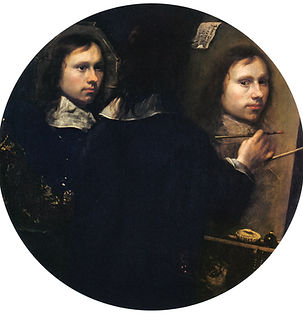
I have now reached the end of this text, which itself becomes part of my attempts to break down the boundaries between text, painted image and moving image, at the intersection of increasingly vertiginous games of mirrors in which I see myself reflected — as in Johannes Gumpp’s Double Self-Portrait (1646) (ill. 7), or in Orson Welles’s The Lady from Shanghai, when the protagonists find themselves trapped in the mirror maze of a hall of mirrors, confronted with endlessly multiplied images of themselves.
But to what end?
The subject underlying the artistic practice I have just attempted to summarise is clearly the woman who paints, films herself, writes, reflects, searches for herself, looks at herself in a mirror, splits herself into models and painters, and wears a mask.
Does this device reveal an obsession — the desire to track down the I that stands at the intersection of all the reflections returned by these mirrors, each one offering another of the self’s infinite possibilities, like a Cubist self-portrait? Or does it reveal an absence, a void to be filled by these endless games of doubling? The same absence I identified in Nikolai Raïnov at the conclusion of my thesis: the absence of an I capable of expressing itself?
But does this I even exist in any absolute sense, other than by becoming embodied through the mediation of another? How can we look it directly in the face without risking its loss, like Orpheus and Eurydice? Or without becoming lost in an eternally unfulfilled desire, like Narcissus? Or does the self exist only by externalising itself in ever-changing forms?
Perhaps I am now able to understand that ut pictura poesis is an endless game of mirrors in the quest for a synthesis between text and image — a game that ultimately imprisons anyone who ventures to believe that everything resembles everything else. And perhaps comparison, intersection and the assimilation of one into the other exist only through movements of reprise, from one to the other.
In my film, the Painter explains to the Model the meaning Kierkegaard gives to reprise (11): a form of remembering that “carries us forward,” allowing an act finally to become embodied; something the philosopher likens both to a leap into the unknown — the leap of faith — and to a rebirth.
Through this movement, repetition ceases to be the repetition of the same, ceases to be a repetition turned towards the past and memory. Instead, it becomes a passage from the possible to the real, from one iconographic form to another, from one medium to another, from one language to another, from one artistic language to another.
But this comes at the cost of effort, of a struggle with oneself, like Jacob wrestling with the angel.
A movement of “creative reprise” through which the self can become embodied and transformed, leaving the realm of the same to enter the realm of otherness — an embodiment that is itself metamorphosis.
___________________________________________________________________________
Bibliographie
Didi-Hubermann Georges, L’Image survivante, Paris, Minuit, 2002.
Haenel Yannick, Bleu Bacon, Paris, Stock, 2024.
Kierkegaard Soren, La Reprise, traduction Nelly Viallaneix, Paris, Garnier Flammarion 1990.
Klossowski Pierre, Nietzsche et le cercle vicieux, Paris, Mercure de France, 1969.
Nietzsche Friedrich, Considérations inactuelles I et II, traduction Pierre Rush, Paris, Gallimard, Folio essais, 1990.
Vrinat Isabelle, Nikolaj Rajnov ou la quête d’une impossible synthèse (Le modernisme bulgare à l’aube du 20e siècle), thèse de doctorat, Paris III, Sorbonne nouvelle, UFR de littératures comparées, soutenue en 1996 sous la direction de Michel Cadot.
Warburg Aby, Essais florentins, Paris, Hazan, 2015.
Notes :
1 Haenel Yannick 2024 : 170.
2 Vrinat Isabelle 1996.
3 Klossowski Pierre : 1969.
4 Mirando il punto a cui tutti li tempi son presenti : Dante, Paradiso, Canto XVII, v 17-18.
5 A travers l’analyse de Georges Didi-Huberman 2002.
6 Warburg Aby 2015.
7 Nietzsche Friedrich 1990.
8 Ibid.
9 Excerpt from my screenplay The Painter and the Model (2023).
10 With the exception of Jacques Rivette’s La Belle Noiseuse (1991), a free adaptation of Balzac’s The Unknown Masterpiece. In its longer version, the film takes the time to show a painter, played by Michel Piccoli, making sketches in real time from a model played by Emmanuelle Béart — although the hands we actually see drawing on screen are those of the painter Bernard Dufour.
11 “Gjentagelsen,” translated into French either as La Répétition (Repetition) or, by Nelly Viallaneix, as La Reprise (Reprise), a translation choice she discusses in her introduction to Kierkegaard (1990).

Nikolaï Raïnov, couvertures des Yeux de l'Arabie, 1918 et des Contes du soleil, 1918

Illustration 2

Ill 3 : La, peintre e la modèle aux marionnettes 3, 2021

Ill. 4 : image du film La peintre et la modèle

Ill. 5 : Juliette pose en boxant avec des marionnettes, 2023